Symptoms and Diagnosis
Acne vs Herpes: How to Tell the Difference
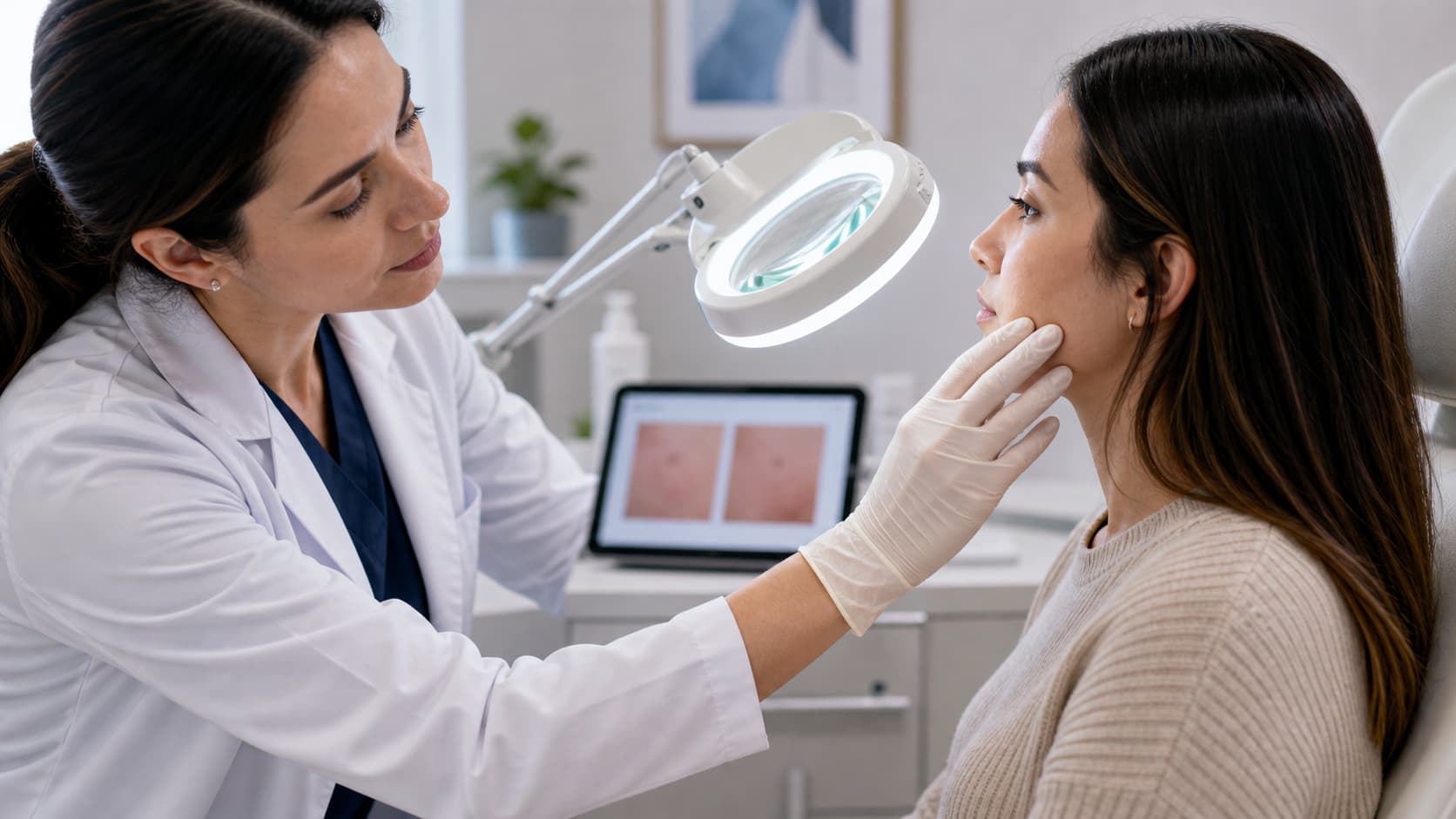
Acne and herpes can look remarkably similar in their early stages, but they differ in ways that are identifiable if you know what to look for. Acne lesions are comedone-based (blackheads, whiteheads, or infected follicles), appear on sebaceous skin surfaces (face, chest, back), and don't produce the clustered fluid-filled blisters or painful ulcers characteristic of herpes; genital or perianal herpes appears in non-acne-prone areas, occurs in clusters, evolves from vesicles to ulcers within 24 to 48 hours, and is preceded by tingling or burning — a PCR swab from any active lesion provides a definitive answer without waiting.
The Core Biological Difference
Acne and herpes are caused by entirely different mechanisms. Acne results from: excess sebum production — oil clogging the pore; proliferation of Cutibacterium acnes (formerly Propionibacterium acnes) within the blocked follicle; inflammatory response to bacterial products. The anatomical requirement: a sebaceous (oil-producing) hair follicle. Acne only occurs where sebaceous follicles are dense — primarily the face, upper chest, upper back, and shoulders. The genitals have relatively few sebaceous follicles, which is why typical acne is uncommon in the genital area. Herpes results from: HSV-1 or HSV-2 replicating in epithelial cells after emerging from sensory nerve latency; direct cytopathic effect killing infected cells; vesicle formation from cell death and fluid accumulation; ulceration when vesicles rupture. Herpes doesn't require hair follicles or sebaceous glands — it occurs wherever the virus reactivates from its latent ganglionic location, which is anatomically specific to the innervation territory of the affected sensory nerve.
Morphological Differences: What Each Looks Like
Acne lesion types and their characteristics: non-inflammatory — open comedone (blackhead): follicular plug exposed to air; closed comedone (whitehead): follicular plug covered by skin; inflammatory — papule: solid red bump without visible pus (infected follicle); pustule: red base with visible yellow-white pus center (the classic "pimple"); nodule/cyst: deep, large, painful lesion without a defined head. Herpes lesion progression: prodrome stage — tingling, burning, or itching at the site, 12 to 48 hours before lesions appear; papule — small red raised bumps, similar in appearance to early acne at this stage; vesicle — fluid-filled blisters on a red base, usually in a cluster of 2 to 10 or more, each vesicle 1 to 4mm; ulcer — vesicles rupture within 24 to 48 hours, leaving shallow, painful ulcers with a gray or yellow center and red border; crust — ulcers heal with crusting; resolution — complete healing over 7 to 14 days (recurrent) or 2 to 4 weeks (primary). The key distinguishing features: herpes occurs in clusters of multiple lesions; acne lesions are typically isolated. Herpes vesicles contain clear serous fluid; acne pustules contain purulent (pus) material. Herpes lesions progress to open ulcers; acne resolves by absorbing or expressing its contents. Herpes is preceded by a neurological prodrome (tingling/burning); acne has no prodrome.
Location: A Critical Differentiator
Location provides important diagnostic information before any test is done. Face: acne is common; facial herpes (herpes labialis) from HSV-1 is common, typically occurring on or near the lip border. Both can occur on the face, but the lip margin is the signature location for oral herpes. Genitals (labia, penis shaft, glans, perianal): herpes is one of the most common causes of genital lesions; acne is uncommon here due to limited sebaceous follicle density. A pimple-like lesion on the genitals is more likely to be herpes, folliculitis, or molluscum contagiosum than true acne. Back, chest, upper shoulders: primarily acne territory; herpes simplex rarely affects these areas (herpes zoster/shingles can, but that's a different virus). Buttocks and inner thighs: herpes is common here — this is frequently overlooked as a herpes location; acne can occur but is less common.
Timeline After Sexual Exposure
One of the most useful clinical discriminators is timing relative to potential exposure. Acne has no temporal relationship to sexual activity. Herpes primary infection: symptoms appear 2 to 12 days after exposure (average 4 days). A genital lesion appearing 4 to 7 days after a new sexual partner is statistically more likely to be herpes than acne. Recurrent herpes: outbreaks are triggered by stress, illness, menstruation, or UV exposure — not by new sexual exposure. The classic patient concern: "I was with someone new 5 days ago and now I have a pimple on my penis" — the correct response is to evaluate for herpes immediately with a PCR swab, not to reassure the patient it's acne without testing.
Diagnosis: What Test to Get and When
For any suspicious genital lesion: PCR swab from an active vesicle, ulcer, or crusted lesion is the most accurate test. It identifies HSV type and provides results in 1 to 3 days. Critically, it doesn't require waiting for any window period — it detects viral DNA directly from the lesion regardless of how recently the exposure occurred. Don't wait for the lesion to heal before swabbing — viral DNA concentration is highest during the vesicular and early ulcer stages. If the lesion has healed and you want to know your herpes serostatus: type-specific HSV-1 and HSV-2 IgG blood test, at 6 to 16 weeks after potential exposure. Don't use acne treatments (benzoyl peroxide, salicylic acid, retinoids) on herpes lesions — they will irritate the raw ulcerated skin and delay healing. Don't use herpes antivirals (valacyclovir) on acne — they're ineffective for acne.
For herpes PCR from active lesions or type-specific IgG serology, Health Test Express offers panels with results in 1 to 2 days.
When to Seek Evaluation
See a provider immediately for swab testing if: you have a new genital sore, blister, or cluster of bumps appearing within 2 weeks of sexual exposure; a genital lesion is painful, evolving, or accompanied by fever or swollen lymph nodes; a lesion doesn't have the classic comedone structure of acne (no blackhead or whitehead core); you have a partner who has disclosed a herpes diagnosis. Don't wait: herpes PCR during an active lesion is significantly more sensitive than after the lesion heals.
Frequently Asked Questions
Can you get acne on the genitals?
True acne (comedone-based sebaceous follicle blockage) is uncommon on the genitals because the genital skin has fewer sebaceous follicles than the face or back. Folliculitis (infected hair follicles from shaving), sebaceous cysts, and Fordyce spots are often mistaken for acne in this area. A pimple-like lesion on the genitals is more likely to be folliculitis, herpes, molluscum, or HPV than true acne.
How quickly does herpes look different from acne?
Within 24 to 48 hours of the first papule appearing, herpes lesions develop into fluid-filled vesicles and then rupture to form ulcers — which acne never does. If a bump progresses to a fluid-filled blister and then an open sore within 1 to 2 days, herpes is the diagnosis until proven otherwise by PCR.
Does herpes look like a whitehead pimple?
Herpes vesicles are filled with clear serous fluid, not the yellow-white pus of a whitehead. They're clustered (multiple lesions together), whereas whiteheads are typically individual. A whitehead has a visible comedone (plugged follicle); a herpes vesicle does not. The distinction is visible on close inspection, though PCR swab testing provides definitive confirmation.
Related: Herpes or pimple? · STD with pimples · First signs of herpes · Ingrown hair or herpes? · Get tested today
This article is for informational purposes only and does not constitute medical advice.
Herpes or Pimple?
Answer 7 quick questions about what you're seeing. This quiz helps you understand what the bump might be — it does not replace a medical diagnosis.
Question 1 of 7
Where exactly is the bump or cluster?
This quiz is for educational purposes only and is not a medical diagnosis. Only a laboratory test can confirm or rule out herpes. When in doubt, get tested.
Don’t Know What Could Be Causing Your Symptoms?
Get the complete STD test panel and take control of your health!


Dr. Michael Thompson is an expert in sexually transmitted diseases with extensive clinical and research experience. He leads campaigns advocating for early diagnosis and prevention of diseases like HIV and gonorrhea. He collaborates with local organizations to educate both youth and adults about sexual health.