Symptoms and Diagnosis
Syphilis Window Period: When to Test
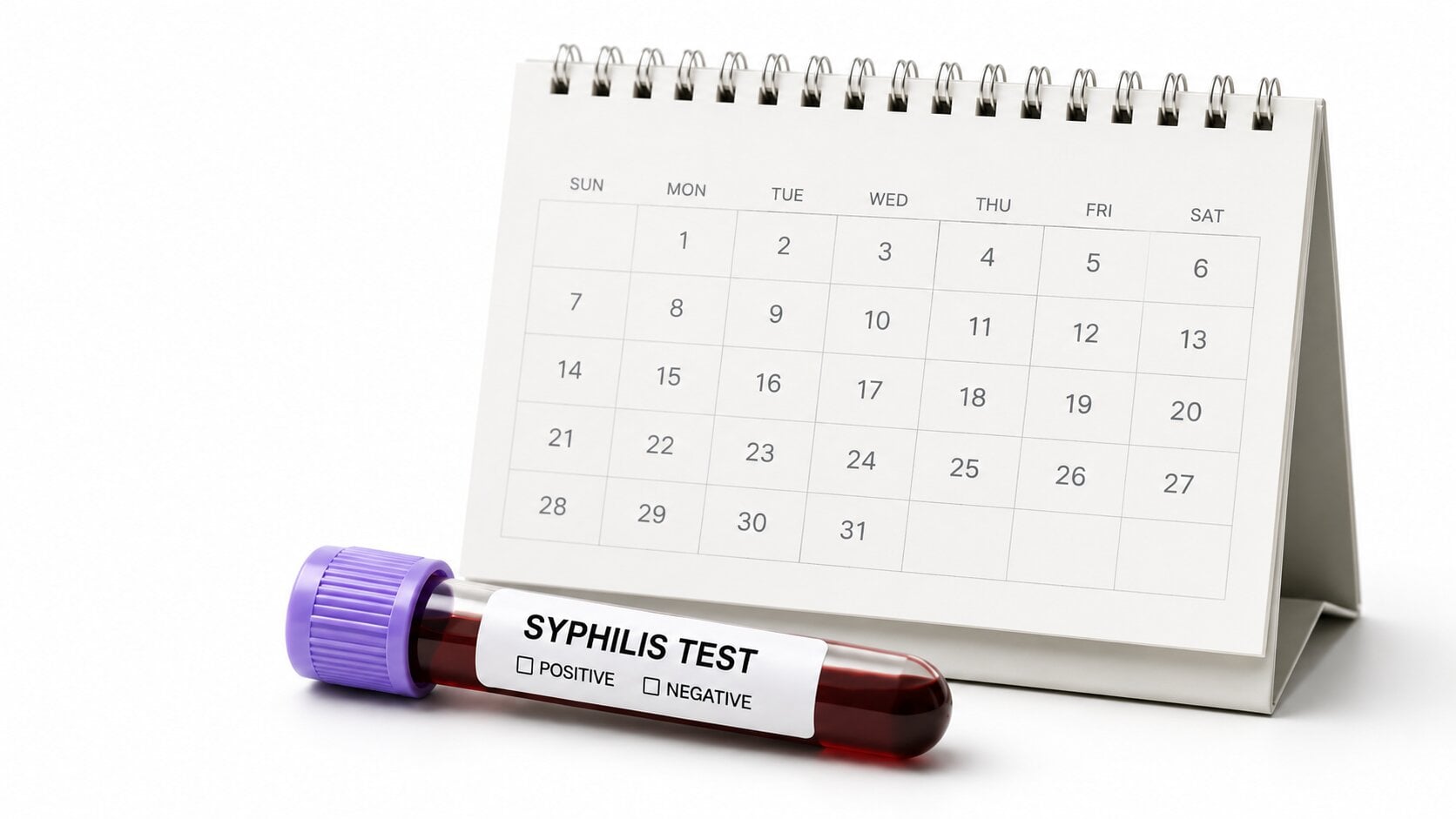
Syphilis has the longest and most variable window period of the common bacterial STDs — and the answer changes depending on which test you use and which stage of infection you're in. The RPR (non-treponemal) test typically becomes reactive 21 to 45 days after exposure, but can take up to 90 days in some cases; treponemal tests (TPPA, FTA-ABS, EIA) become reactive earlier, often at 2 to 3 weeks; and the presence of an active primary chancre does not guarantee a positive blood test, because serology lags behind the appearance of the sore.
Why Syphilis Has Such a Complex Window Period
Treponema pallidum doesn't produce a robust early immune response the way many bacteria do. The spirochete has evolved mechanisms that suppress the immediate innate immune response, allowing it to establish systemic dissemination before the adaptive immune response — the source of the antibodies that serology tests detect — is fully activated. The result: a person can have an active, infectious primary syphilis chancre for weeks before any standard blood test becomes positive.
This is the paradox that confuses most patients: "I have a sore but my blood test is negative." Both can be true simultaneously during the early primary stage. The sore is real and infectious; the blood test is not yet reactive because antibody levels haven't reached the detection threshold.
The Two Test Types and Their Different Windows
Syphilis testing uses a two-tier approach, and each tier has a different window period. Non-treponemal tests (RPR, VDRL): these detect non-specific antibodies (reagin) produced in response to lipoidal antigens released during T. pallidum infection and host tissue damage. They typically become reactive 21 to 45 days after exposure in primary syphilis. In some cases, particularly with low-bacterial-burden exposure, reactivity may not appear until 60 to 90 days. The RPR is used for screening and titer monitoring (higher titers indicate more active infection; declining titers confirm treatment response). Treponemal tests (TPPA, FTA-ABS, EIA, chemiluminescence immunoassay): these detect antibodies specific to T. pallidum proteins. They become reactive earlier than RPR — often as early as 2 to 3 weeks after exposure. Once reactive, treponemal tests remain positive for life even after successful treatment (this is used diagnostically but can create confusion for people with prior treated syphilis).
The Reverse Sequence Algorithm: What the CDC Now Recommends
The 2024 CDC Laboratory Recommendations for Syphilis Testing changed the standard testing algorithm in a way that affects window period interpretation. The traditional algorithm: RPR screening first, then treponemal confirmatory if reactive. The reverse algorithm (now recommended): treponemal EIA or CIA as the screening test first, then RPR if reactive. The clinical implication for window periods: the reverse algorithm detects infection slightly earlier (treponemal tests have a shorter window than RPR) and reduces false positives from biological RPR false positives (which occur in pregnancy, autoimmune conditions, and recent viral infections). However, the reverse algorithm creates a new challenge: a positive treponemal test with a negative RPR may represent very early primary syphilis (pre-RPR seroconversion), previously treated syphilis (where treponemal tests remain positive for life), or a false positive treponemal result. Ask your provider which algorithm your lab uses — it affects how to interpret your results.
Stage-Specific Window Period Guidance
Primary syphilis (chancre present): RPR window 3 to 9 weeks; treponemal window 2 to 3 weeks. A person with an active chancre may have a negative RPR for weeks while being maximally infectious. If you have an active genital or oral sore and syphilis is suspected, tell your provider — dark-field microscopy or PCR of the lesion exudate can confirm syphilis without waiting for serology. Secondary syphilis (rash, mucous patches, systemic symptoms): RPR is almost always strongly reactive with high titers; rarely negative (prozone phenomenon, below). Both treponemal and non-treponemal tests are reliable at this stage. Latent syphilis (no symptoms): both tests remain positive throughout latency. The window period is not relevant at this stage — if you had untreated syphilis that entered latency, you are detectable.
Prozone Phenomenon: When Secondary Syphilis Tests False Negative
In secondary syphilis with very high RPR titers, a paradoxical false negative can occur — the prozone phenomenon. Excess antibody at very high concentrations blocks the agglutination reaction that makes the RPR positive. Laboratories address this by performing serial dilutions when secondary syphilis is suspected but RPR is unexpectedly negative. If you have a classic secondary syphilis rash and a negative RPR, request that the lab perform dilutions before concluding the test is truly negative.
Recommended Testing Timeline After Potential Syphilis Exposure
High-risk exposure (known contact with syphilis-positive partner, or unprotected sex with a partner of unknown status): test at 21 days for a preliminary treponemal result. Retest at 45 days (RPR standard window). Retest again at 90 days for definitive negative. Moderate-risk exposure (unprotected sex, unknown partner status): test at 45 days as a reasonable initial window. Retest at 90 days if initial test is negative and concern persists. Routine screening without specific exposure: annual testing for MSM and people with multiple partners is standard CDC guidance. A negative at any point in routine screening is actionable — the window period applies specifically when a timed exposure is known.
Serofast Syphilis: Understanding Persistent Positive RPR
After treatment for syphilis, the RPR titer should decline and ideally reach non-reactive status. However, in some patients — particularly those treated for late latent or tertiary syphilis, or those treated when titers were very high — the RPR remains weakly reactive at a low titer (typically 1:4 or lower) indefinitely. This is called serofast syphilis and does not represent active untreated infection; it's a residual immunological memory. Distinguishing serofast from reinfection or treatment failure requires: comparing current titer to the post-treatment titer (a 4-fold increase suggests reinfection); clinical assessment for symptoms; judgment about new exposure risk. This context matters for window period discussions — a person with serofast syphilis who worries about a new exposure may see a treponemal positive and RPR positive and interpret it as new infection when it's actually residual from prior treated disease.
For syphilis RPR and treponemal testing with results in 1 to 2 days, Health Test Express offers panels without a GP referral.
When to Seek Urgent Evaluation
Don't wait for the scheduled window period test if: you have a painless genital or oral ulcer appearing 3 weeks after potential syphilis exposure (likely a primary chancre — PCR swab and dark-field microscopy can confirm before serology is positive); you develop a non-itchy rash on palms and soles with fever and lymphadenopathy (secondary syphilis — highly treatable and highly infectious, needs diagnosis now); you have neurological symptoms (severe headache, vision or hearing changes, weakness) and a history of untreated syphilis (possible neurosyphilis).
Frequently Asked Questions
Can syphilis show up on a blood test in 1 week?
Not reliably. The earliest treponemal tests may become reactive at 2 to 3 weeks in some individuals, but 1 week is before even the earliest detectable window for any syphilis test. A negative result at 1 week is not meaningful for ruling out infection.
Can I have syphilis with a negative blood test?
Yes — during early primary syphilis, before serology has converted. A person with an active chancre may have a negative RPR and even a negative treponemal test during the first 1 to 2 weeks after the sore appears. Dark-field microscopy or PCR of the lesion is diagnostic during this early period.
How long does it take for syphilis antibodies to appear?
Treponemal antibodies: 2 to 3 weeks in most people. Non-treponemal antibodies (RPR): 3 to 6 weeks in most people, up to 90 days in some. The 90-day window is the conservative recommendation for a definitive negative from a specific exposure.
Does a negative syphilis test at 6 weeks rule it out?
In most cases, yes. By 6 weeks, the RPR is reactive in the majority of primary syphilis infections and virtually all secondary syphilis cases. However, the conservative standard is 90 days for a definitive negative from a timed exposure. If you test negative at 6 weeks and have had no further exposures, a 90-day test provides final confirmation.
Related: Syphilis symptoms in women · How does syphilis spread? · STD window period guide · False positive STD test · Get tested today
This article is for informational purposes only and does not constitute medical advice.
When Should You Get Tested?
Testing too early can give a false negative. Answer 4 questions and we'll tell you when each test becomes accurate.
Question 1 of 4
What type of exposure are you concerned about?
This tool provides general guidance based on CDC-recommended window periods. It is not medical advice. Consult a healthcare provider for personalized recommendations. If you're within 72 hours of HIV exposure, ask about PEP immediately.
Don’t Know What Could Be Causing Your Symptoms?
Get the complete STD test panel and take control of your health!


Dr. Michael Thompson is an expert in sexually transmitted diseases with extensive clinical and research experience. He leads campaigns advocating for early diagnosis and prevention of diseases like HIV and gonorrhea. He collaborates with local organizations to educate both youth and adults about sexual health.