Symptoms and Diagnosis
Gonorrhea Window Period: How Long After Exposure Should You Get Tested?
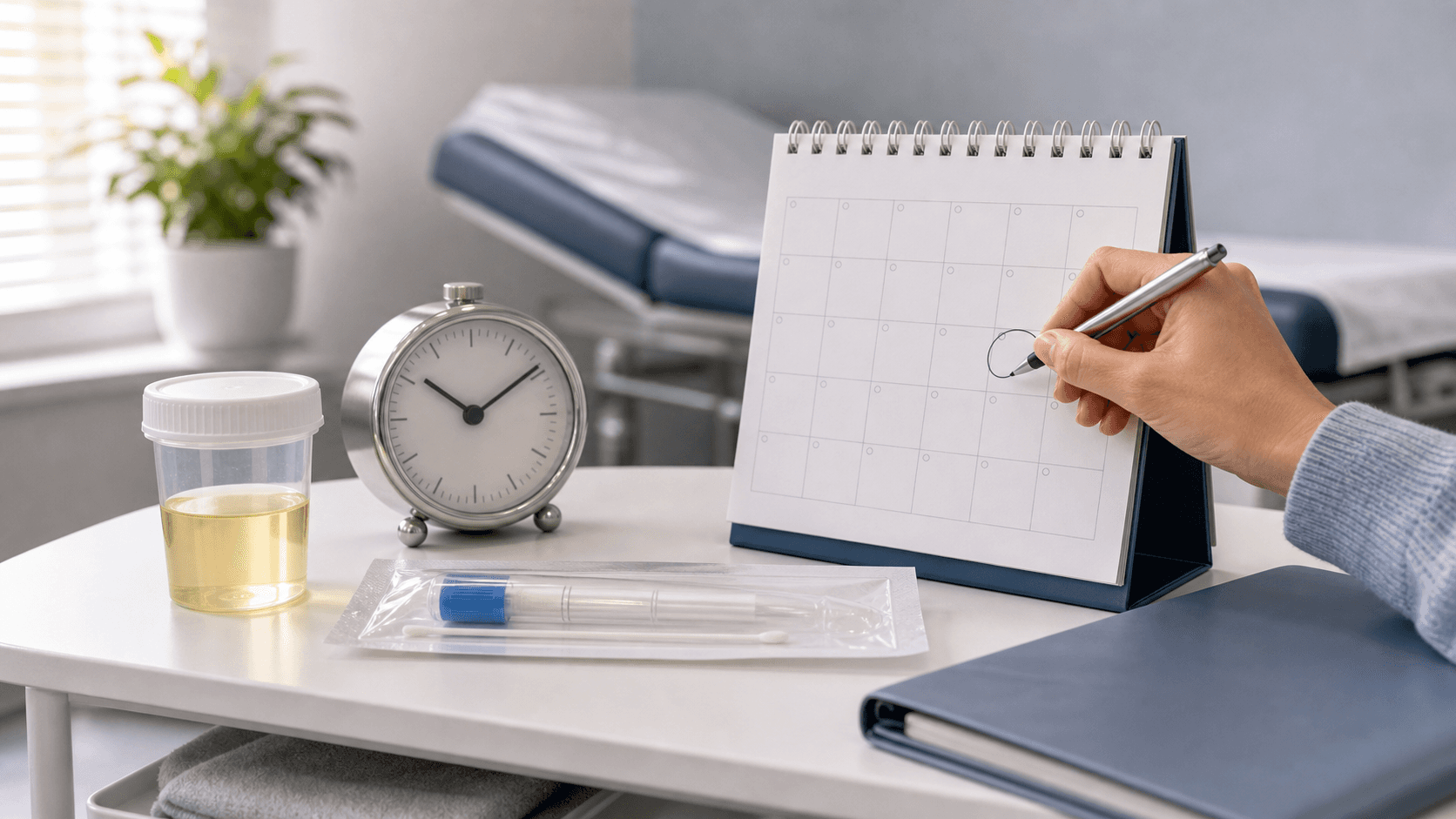
Gonorrhea has one of the shortest window periods of any STD — which is both good news and bad news. Gonorrhea NAAT becomes reliably positive as early as 3 to 5 days after exposure in many cases, with 14 days being the recommended wait for a definitive negative; gonorrhea also produces symptoms faster than most STDs (1 to 14 days, typically 2 to 5 days in men); but pharyngeal and rectal gonorrhea have distinct testing windows and are missed by urine tests entirely.
Why Gonorrhea Has a Short Window Period
Neisseria gonorrhoeae is a fast-replicating bacterium — under ideal conditions it divides approximately every 30 to 60 minutes. Unlike herpes (which requires weeks for IgG antibody development) or HIV (which requires weeks for immune response), gonorrhea is detected directly by NAAT — the test amplifies bacterial DNA, not antibodies. As soon as bacterial load at the infection site is sufficient to produce detectable DNA in the specimen, the test will be positive. This typically occurs within 3 to 5 days of exposure at genital sites in symptomatic cases.
Recommended Testing Windows by Site
Urogenital gonorrhea (urine NAAT or cervical/urethral swab): minimum 5 to 7 days after exposure; 14 days for a reliable negative. Testing at 3 days after exposure will sometimes be positive but has a meaningful false negative rate. At 14 days, virtually all genuine infections are detectable.
Pharyngeal gonorrhea (throat swab NAAT): similar to urogenital, with some evidence that pharyngeal colonization takes slightly longer to reach detectable levels. The 14-day window applies here as well. A negative throat swab before 7 days is not reassuring.
Rectal gonorrhea (rectal swab NAAT): again, 14 days is the recommended minimum for a reliable result. Rectal gonorrhea is almost always asymptomatic, making the window period especially important — there will be no symptoms to indicate when infection occurred.
Symptoms vs Testing Window
In men with symptomatic urethral gonorrhea, symptoms typically appear 2 to 5 days after exposure — before the recommended 14-day testing window. This creates a practical scenario: a man has discharge and burning at day 4, tests positive on a NAAT, and gets treated. This is appropriate — a positive test at day 4 is a true positive. The window period matters for interpreting a negative result, not a positive. If the test is positive, the timing doesn't change the clinical interpretation.
After a High-Risk Exposure: Testing Strategy
Immediately after exposure: testing too early (within 1 to 3 days) is not meaningful; wait at least 5 to 7 days for a preliminary result. At 14 days: test for gonorrhea (all relevant sites), chlamydia, and syphilis. A negative at 14 days is reassuring for gonorrhea specifically. Also test at 45 days for syphilis (which has a longer window period) and at 45 to 90 days for HIV. Don't stop at gonorrhea alone after a high-risk sexual exposure — co-testing for all relevant infections is appropriate.
For fast private gonorrhea NAAT testing with results in 1 to 2 days, Health Test Express offers comprehensive panels without a GP referral.
Frequently Asked Questions
Can gonorrhea show up on a test in 2 days?
Sometimes, if bacterial load is already high enough to detect — particularly in symptomatic urethral infections. But a negative at 2 days is meaningless. A positive at 2 days is a true positive and should be treated.
How long does gonorrhea take to show symptoms?
In men who develop symptoms: typically 2 to 5 days after exposure (range 1 to 14 days). Women are mostly asymptomatic. Rectal and throat gonorrhea are almost always asymptomatic regardless of sex.
Does a negative gonorrhea test at 1 week rule it out?
Not definitively. At 7 days, most true infections are detectable but not all. A negative at 7 days with low exposure risk is reassuring. For a definitive negative, retest at 14 days.
Related: How to test for gonorrhea · Oral gonorrhea symptoms · STD window period guide · Get tested today
This article is for informational purposes only and does not constitute medical advice.
When Should You Get Tested?
Testing too early can give a false negative. Answer 4 questions and we'll tell you when each test becomes accurate.
Question 1 of 4
What type of exposure are you concerned about?
This tool provides general guidance based on CDC-recommended window periods. It is not medical advice. Consult a healthcare provider for personalized recommendations. If you're within 72 hours of HIV exposure, ask about PEP immediately.
Don’t Know What Could Be Causing Your Symptoms?
Get the complete STD test panel and take control of your health!


Dr. Michael Thompson is an expert in sexually transmitted diseases with extensive clinical and research experience. He leads campaigns advocating for early diagnosis and prevention of diseases like HIV and gonorrhea. He collaborates with local organizations to educate both youth and adults about sexual health.